
Rooms designed for more
Where purpose meets pleasure.
My husband often jokes that I think form before function.
He means it teasingly, of course. Function matters enormously. But I have never believed it should be the only thing that matters.
The phrase comes from the modernist idea that form should follow function, a principle that shaped much of twentieth-century design and later became closely associated with Bauhaus thinking.
It makes sense. A room should work.
But somewhere along the way we seem to have taken that idea a little too literally, especially in the spaces we use most.
Bathrooms reduced to rows of identical tiles and oversized mirrors. Kitchens treated as little more than storage and appliances. Laundries designed to disappear behind a door.
Efficient, yes, but also strangely careful, as though they are not meant to say anything at all.
And yet we spend hours in them.
Perhaps the problem is not that these spaces are functional.
It’s that we’ve rarely allowed them to be anything more.
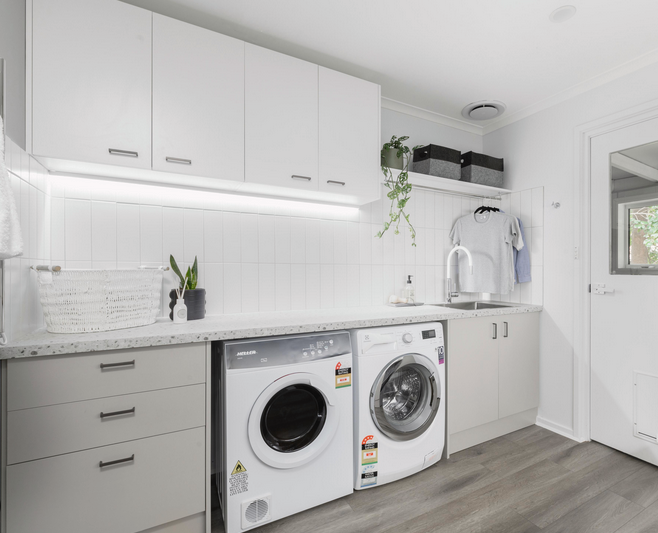
Does this laundry make you want to do the washing? It makes me want to run the other way.
The rooms we inhabit every day
Why function alone is not enough.
Think about how often you move through these spaces.
Morning light in the bathroom before the house wakes. The kitchen bench becoming the gathering point at the end of the day. The laundry quietly holding the rhythm of family life.
These places frame our routines. They carry ordinary moments and hold conversations, transitions and small pauses.
When we design them purely for efficiency, the atmosphere is usually the first thing to be sacrificed.
Not decoration or drama, but mood.
They become areas we manage rather than places we enjoy, and that feels unnecessary.
How much more pleasant would it be to do the laundry if the room actually felt good? If it had a sense of humour, or simply made you smile instead of rushing through the task?
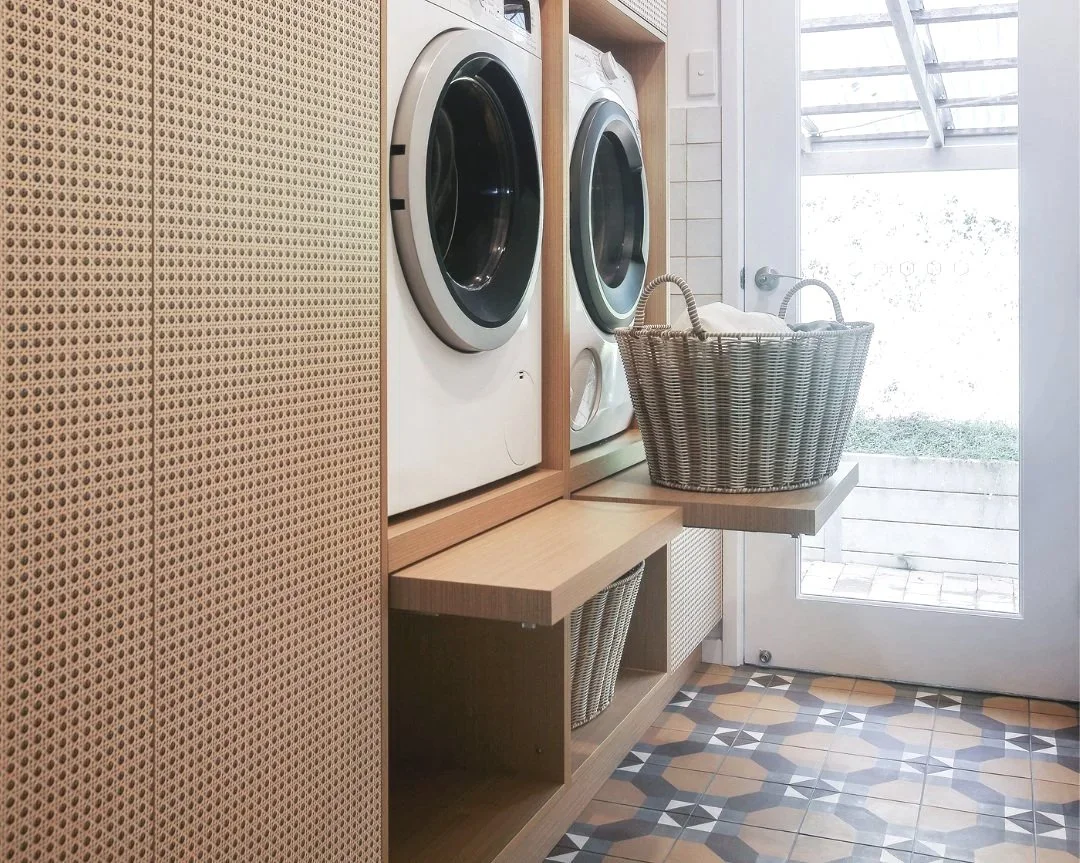
Proof that even rooms designed for function can be elevating and fun.
Depth over default
Atmosphere comes in many forms.
This is not about making every bathroom beige or every kitchen serene.
Your style might be bold, layered, maximalist, colourful, patterned or eclectic.
The point is not restraint.
The point is intention.
I recently designed a bathroom for a client where a Japanese, almost zen-like influence was essential. Calm, restrained and understated.
But that was their language.
Even within that quiet palette, the room carries depth.
There is timber in the vanity. Tiles with subtle variation. Ceramic light fittings casting a soft directional glow. Art on the wall. Woven baskets for storage. A vessel placed deliberately, not as decoration but as presence.
The result feels composed rather than empty, calm but still full of character.
Atmosphere can just as easily come from colour-drenched walls, patterned tiles, vintage brass hooks, layered textiles or unapologetic artwork.
It is not about how much you add.
It is about whether the room feels considered.
Designing a space is not about removing everything until nothing remains to question.
There is a difference between editing and simply holding back.
Editing means making deliberate choices: adding something because it strengthens the room, and leaving something out because it weakens it.
Holding back is different. It stops before a space has the chance to develop any character at all.
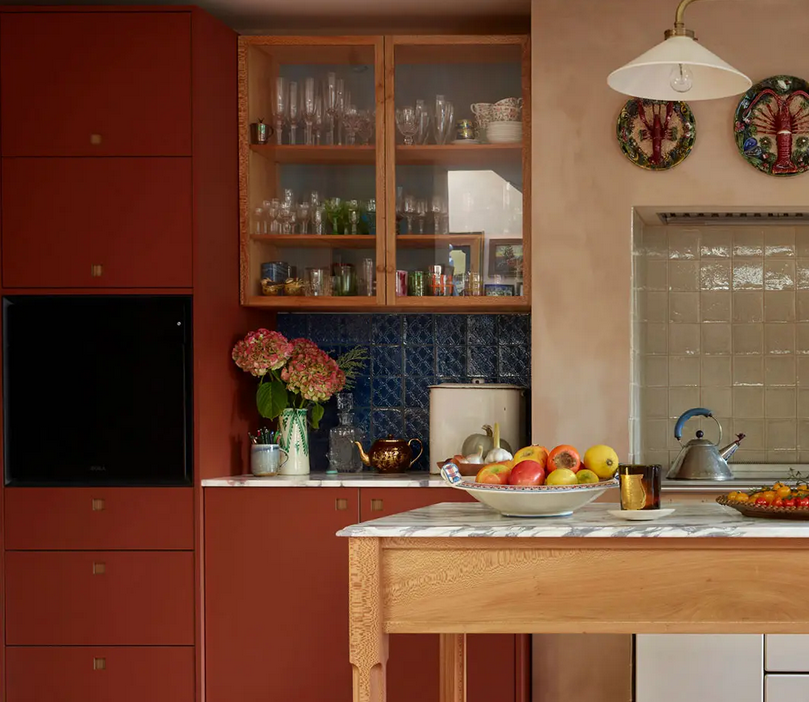
A beautifully layered kitchen.
Small shifts, bold gestures
How to soften a utilitarian room.
You do not need a full renovation to change the mood of a space.
You need intention.
Start with light. Install dimmer switches. Replace a harsh ceiling fitting with a table lamp or wall sconce that casts a gentler glow.
Then be a little braver.
A proper armchair in a bathroom corner if space allows.
A vintage cabinet in the laundry instead of built-in melamine.
An old industrial advertising sign for detergent on the wall.
A timber stool beside a bath.
A real painting in the kitchen, chosen simply because you enjoy looking at it.
In my own kitchen, a small table lamp on the benchtop changes everything in the evening. Music is playing and a soft glow helps me finish the final clean-up. It relaxes the room and quietly signals that the day is coming to an end.
These gestures are not complicated, but they transform how a space feels to inhabit.
Sometimes it’s as simple as placing a small radio in the laundry or a stool where you can sit for a moment while folding clothes.
Suddenly the room stops being treated as purely functional and begins to feel human.
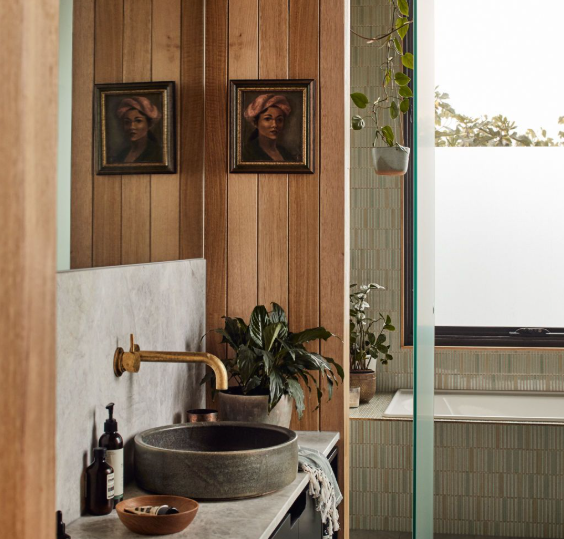
Artwork in the bathroom? Yes please.
Function still matters
Warmth and practicality are not opposites.
None of this suggests ignoring how these rooms work.
Bathrooms need ventilation. Kitchens require durable surfaces. Laundries must withstand water and mess.
Have you noticed how some designers use frilly curtains under kitchen sinks instead of cupboard doors? Charming in photographs.
I tried it in my bathroom some years ago. The fabric became damp, stained easily and slowly lost its shape from constant pulling.
Pretty, yes. Practical, not at all.
I would happily use that same fabric on a window instead.
Not everything that is possible is wise.
Materials can be robust and still beautiful. Lighting can be atmospheric without compromising safety. Furniture can bring warmth without getting in the way.
It comes down to choosing thoughtfully rather than decorating impulsively.
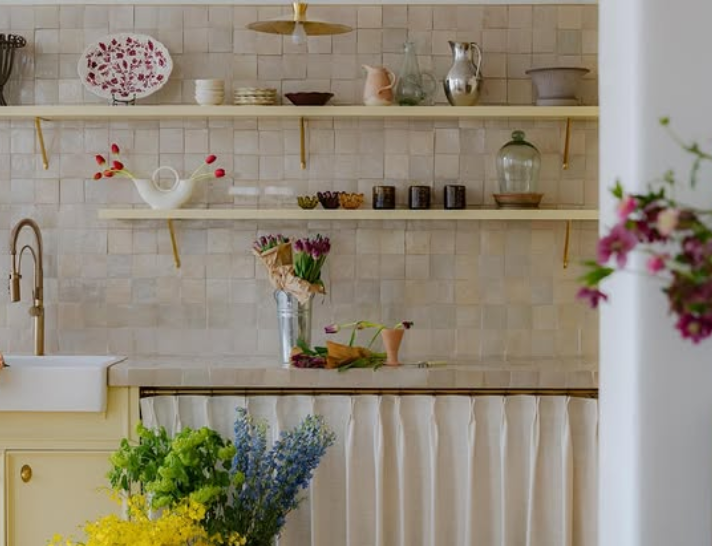
Curtains under kitchen sink…pretty but not practical.
We do not simply cook in the kitchen.
We do not merely wash in the bathroom.
We do not just fold clothes in the laundry.
We live in these spaces.
A home should not feel like a showroom. And certainly not like a museum.
The rooms we move through every day deserve more than pure efficiency. They deserve atmosphere, personality and the small details that make a place feel like it belongs to someone.
When that happens, even the most practical room begins to feel alive.
Until next time.
Vera x